
Our first full day in Botswana started abruptly at 5am when I was jolted into consciousness by a klaxon. It was only when Rhiannon leapt from her bed and fought her way through the mosquito net that I realised it was her phone alarm and we were not in danger of an imminent attack.
It was bitterly cold first thing. We hurriedly got dressed: trousers, t shirts, shirts, jumper and down jackets with our gloves and hats at the ready. All the guide books and the advice we had been given said that we would strip off the top layers as the day progressed. Right at this moment, I doubted I would want to shed a single glove.
At 5:30, we entered the dining hall for breakfast and were met by Ma who provided me with a lovely cup of tea and Rhiannon with a hot chocolate. Breakfast was continental: a bowl of cereal or porridge and a round of toast.
Game drives are the whole point of safaris and our first one began at 6:05am. We clamoured into the back of Joe’s Land Cruiser and met our fellow guests: Tom and Sian from High Wycombe and Brody and Nicole from Southern California. Sian and her family had left Wales at a young age although her elderly parents now live in Derwen Fawr (within a stone’s throw of Lynfa and Robert). She visits regularly and was shocked and saddened when I told her that Swansea M&S had closed). Nicole and Brody married in Italy last month and are on a long honeymoon that involves choosing the next destination at the very last minute.
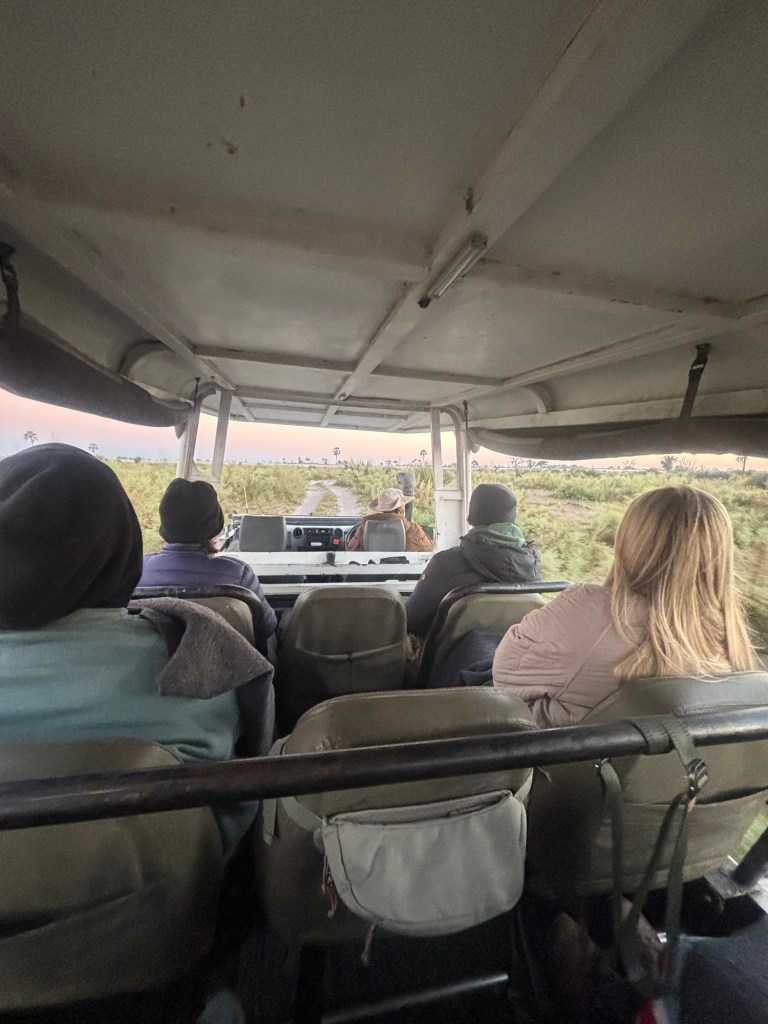
Joe asked us what we wished to see. The four of them answered, “big cats”. Rhiannon and I, about to set off on our very first game drive, wanted to see anything and everything.
Joe was happy to answer questions as he drove. Tom asked if there were leopards around. “Yah,” Joe answered, There were a few although rather shy and elusive. There was one with a tendency to sneak into the village to kill their goats. The locals call him “Mr Villager.”
The first animal we saw was a solitary wildebeest, then a zebra. Joe stopped the truck for photo opportunities. This was necessary because the roads were so bumpy that even Rhiannon struggled to shoot whilst moving.
We were all given fluffy blankets which were a great help in combatting the cold air. The other factor which helped was the excitement and anticipation of what we might see next.
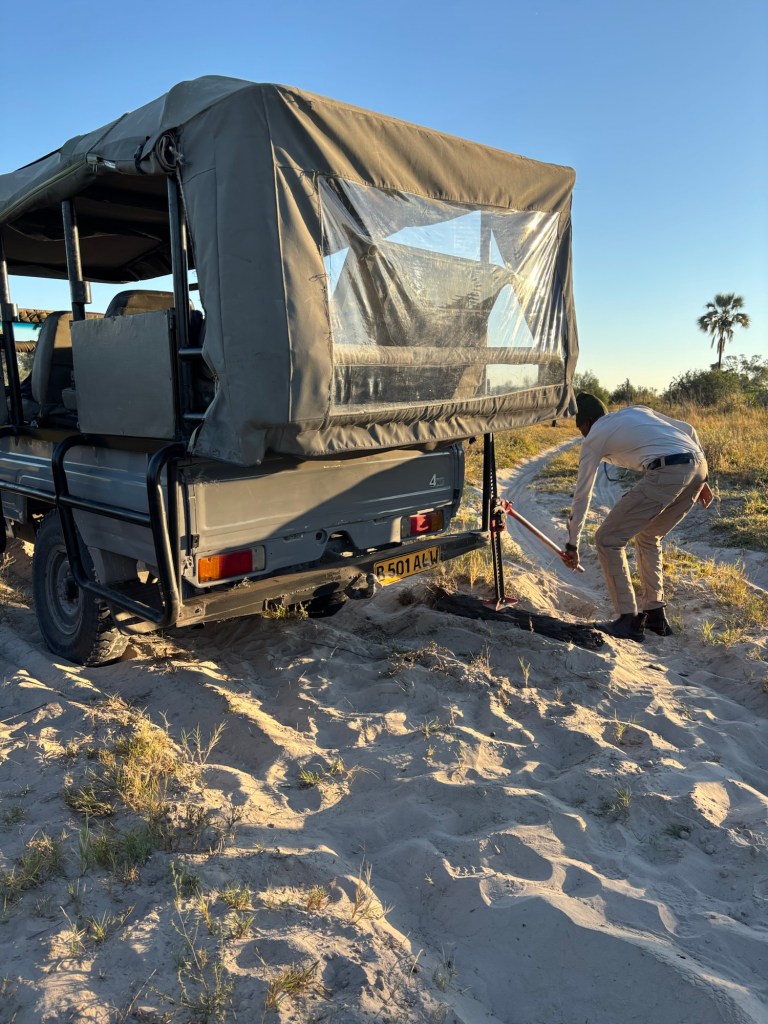
Our high spirits were dampened when Joe announced that the truck had a flat tyre. He set about trying to remove the tyre but struggled with the broken jack. Whilst he persevered, Siân asked if she could please have a bathroom break or a “wild wee”.
The procedure for a wild wee (should you really wish to know) is to ask Joe for permission to go (rather like in school when you ask the teacher). He ensures that the area is safe by walking around clapping his hands and then identifies suitable trees and bushes. He provided Sian with toilet paper and a black bin bag. I had a large pack of wipes and antibacterial gel which I shared with the others.
Eventually, after Joe had done all he could with the tyre, the camp manager ‘TH’ brought a newer vehicle and we all jumped ship truck. Rhiannon and I were sitting in the back seat and I did not notice that this truck had gaps between the seats and the back of the vehicle. That would become significant.
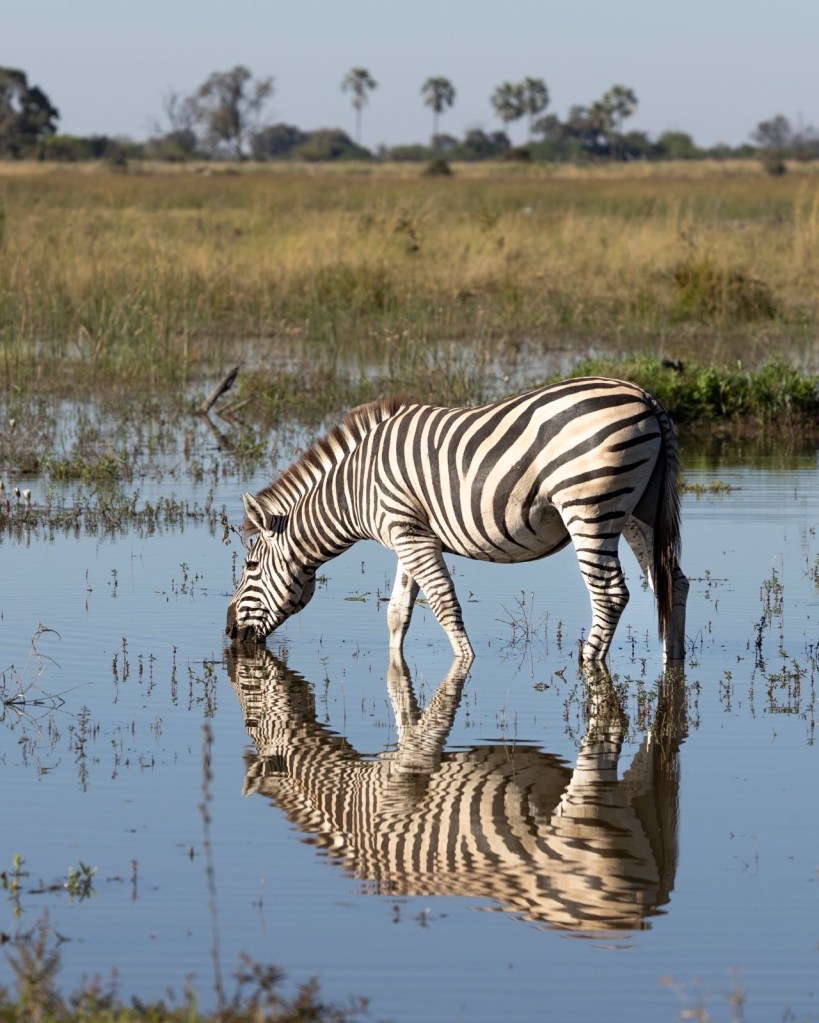
Back on our way with superior wheels, Joe kept scanning the area whilst driving. He seemed able to look in all directions at once including on the ground. Every now and again, he would stop, lean over and scour the dusty track for animals prints. Spotting lion prints, he started to follow the trail, stopping whenever we wanted to take a photograph. We all wanted photos of zebra standing by a watering hole, their stripes reflected in the still water:
After taking my own considerably inferior photo, I popped my phone in my pocket to pick up my Canon camera whenceforth I took a slightly better considerably inferior photo. We drove on with a bump and rocked along the road for five minutes before I realised with a horrible sinking feeling that my phone was no longer in my pocket. I checked the floor and my bag but, now noticing the gap between the seat, I realised what had happened. After breaking the news to Joe and the group, I discovered that I was with a lovely bunch of people. They all insisted immediately that we go back and soon, we were tracking an iPhone rather than a lion. It helped that I knew when and where I had it last had it and, five minutes later, Joe had spotted it, retrieved it and returned it to me unharmed. I learned a very valuable lesson.
As we had lost the lion tracks along the way, Joe did not turn back but went another way. He drove for a while, constantly looking around, always vigilant and clearly very familiar with his surroundings. After seeing ostrich and zebra, we noticed that he had gone very quiet and Brody asked if he could see anything.
“That giraffe,” Joe answered thoughtfully.
We all looked in the direction of his finger and saw, in the distance, a giraffe which, though relatively short, still towered over most of the trees and bushes.
“He’s not eating, see? He’s looking over there,” Joe observed, explaining that giraffes have first rate vision and hearing and are excellent lookouts, often staring in the direction of predators to keep an eye on them, even if they themselves are not in danger.
We all continued to watch the giraffe who, we noticed, was transfixed on something to our left.
After a few more minutes, Joe quietly and calmly said, “lion”. There was a deep and collective intake of breath as we beheld a lioness sweeping nonchalantly towards us. After a few moments, Rhiannon – who had been concentrating so hard on seeing what the giraffe was looking at that she hadn’t heard Joe, proclaimed in a loud whisper, “LION!”
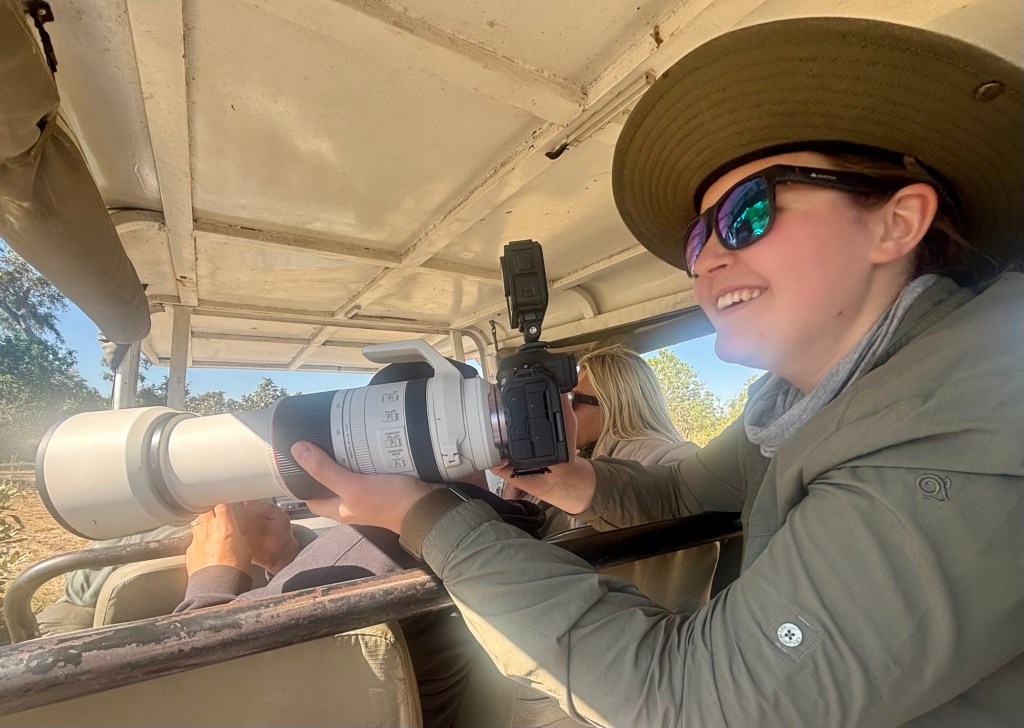
Thrilled at the sight of her first large cat, she leapt into action and I could hear the comforting whir of her camera as Joe quietly announced the arrival of a second lioness. Again, so focused on what she was doing, Rhiannon hadn’t heard and, shortly afterwards, pointed out that there was “A SECOND LION!”
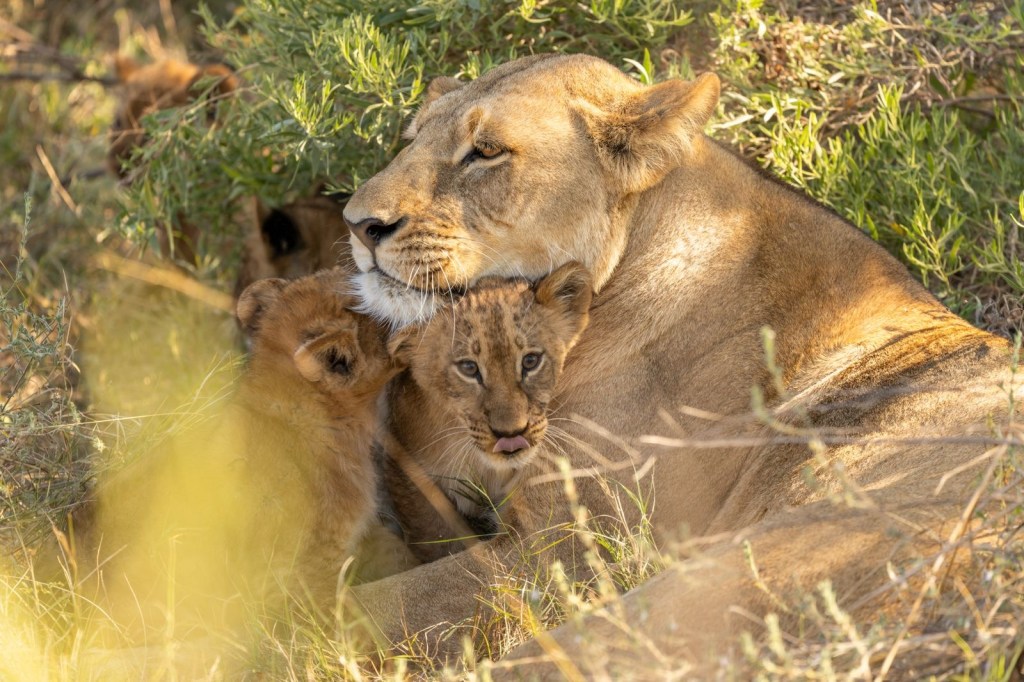
Joe explained that the lionesses were mother and daughter and that each had cubs. He tracked them skilfully and, Rhiannon, now completely intent on finding the cubs, was the first to hear their mewing. Joe waited for them to settle and parked nearby so that we could all see and take as many photos as we wished. Watching the cubs playing and being mischievous and seeing the deep bond between the mothers and their cubs was so overwhelmingly wonderful. I became aware that I was smiling inanely and I saw that everyone else was too.
We stayed with the lions until another truck arrived from a different camp with four eager looking passengers clutching their cameras. I found out that the drivers communicate by radio in their language Setswana and alert each other if there are any major sightings. They do the same if they pass each other on the road. Joe had announced the discovery of the lion family and other trucks were on their way.
As we drove away, Tom turned around and, very kindly, said, “Well Rhian, if you hadn’t lost your phone, we wouldn’t have found the lions!”
By this point, the six of us were getting on so well and had such faith in Joe, that we did not ask where we were going. We just kept trying to spot animals before anyone else.
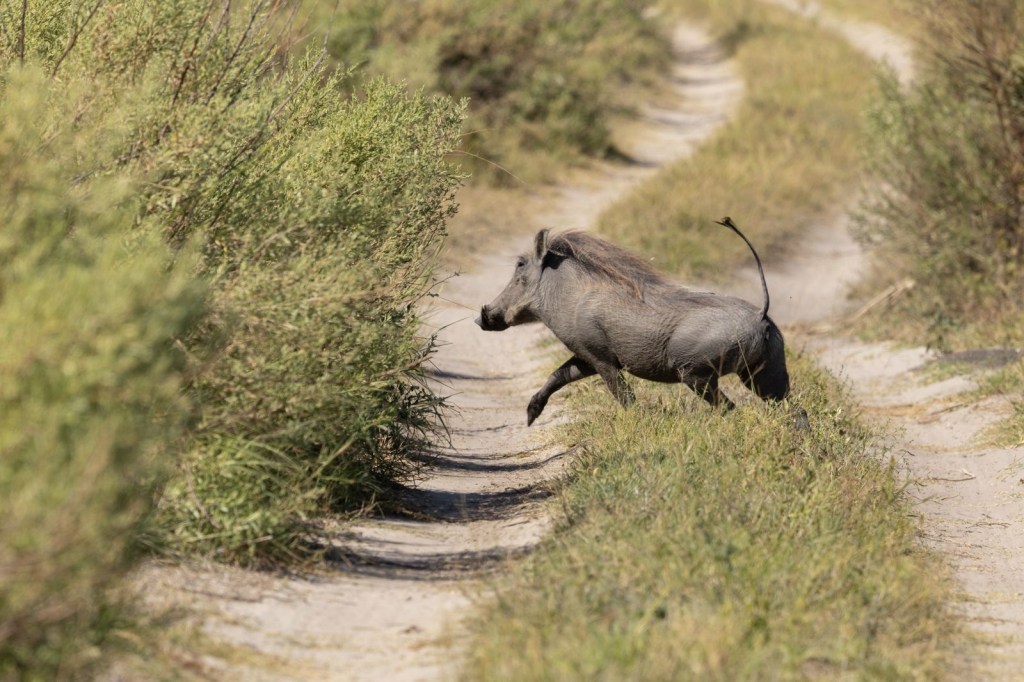
We saw two warthog (“pumbaas”) running in line, their tails upright and springing back and forth. Joe called them their “follow me” tails. ‘Would lions eat them?” Rhiannon asked. “Yes,” Joe answered, “They would only be a snack but they like them very much.”
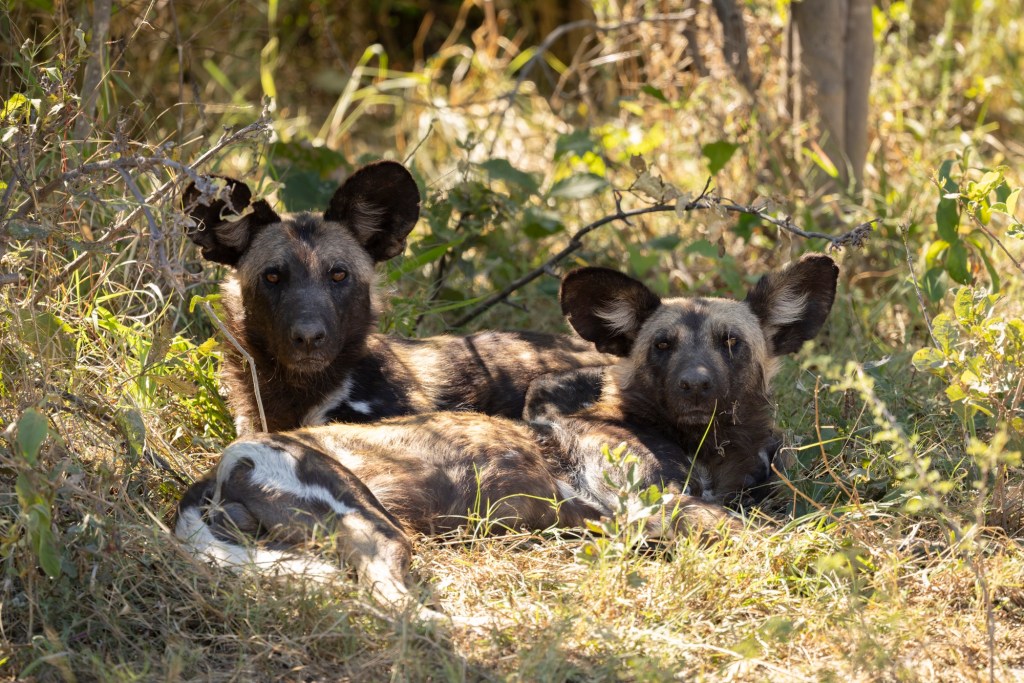
Driving up a track, Joe came to a stop. Rhiannon, always with an eye for anything canine, was the first to see why he had brought us here. “Wild dogs! NO WAY!!” she squealed with excitement, reaching for her camera with a huge grin. She told everyone how rare the wild dog is and that she had never expected to see them. Joe explained that the four ‘painted wolves’ snoozing in the grass next to us were the males, all brothers, and next to them was the entrance to their den where the alpha female rested with her two week old pups. One of the males had been injured and had a noticeable limp.
‘Can I pet them?” asked Nicole. She was joking. Apparently, she has asked this of every guide she has met. Her second question was whether Joe had ever touched a wild animal. “Yah,” he smiled, telling us that as a child he had played a game with his friends where they would dare each other to touch an animal: generally a giraffe or elephant but sometimes, alarmingly, a hippo. Having already learned how dangerously aggressive hippos can be, we were shocked. Joe said that their favourite tactic was to grab the hippos’ tails and, as the hippos ran for the water, to hold tight and be dragged along for as long as possible before, as the hippo turned to bite them, diving “like superman” into the water and swimming away.
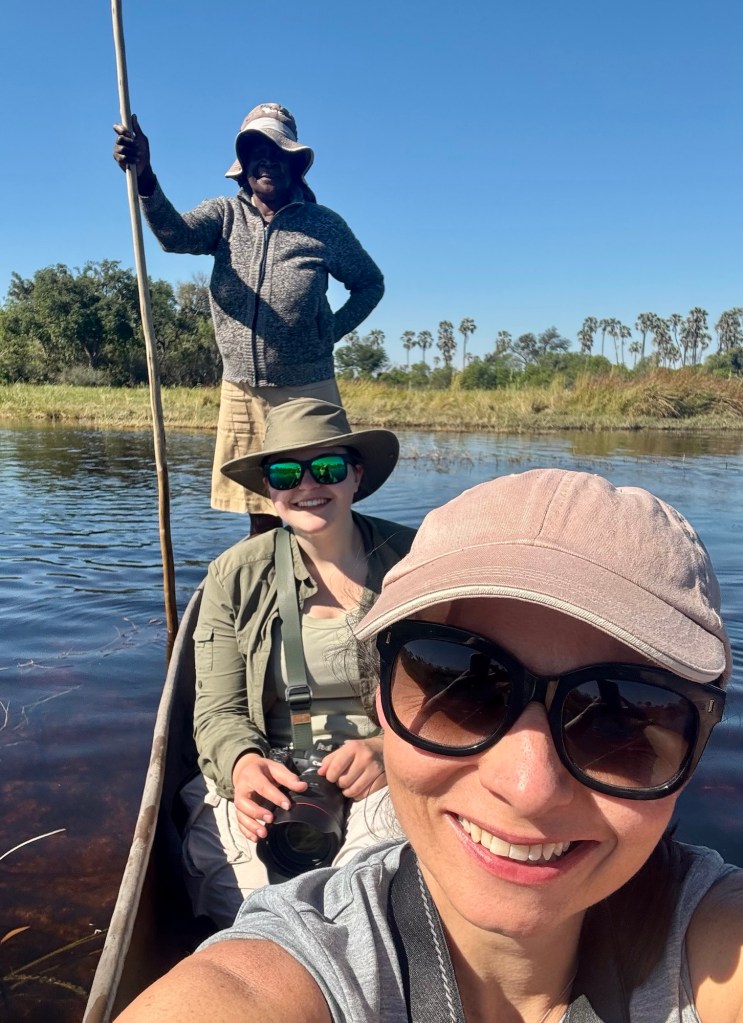
After leaving the dogs, Joe took us to another Mokoro Station where four local villagers – a man and three women – were preparing to take us through the waters for a picnic lunch and nature walk. The man and one women were dressed casually in short sleeves, another woman was in a skirt and smart jacket and the third in a thick grey cardigan. She was our ‘poler’ but the women did not speak English so the man commentated for all of us on the way.
The picnic was good fun and we enjoyed the nature walk during which the guide taught us how to recognise certain animals from the tracks and from “what they have left behind.” He also knew a lot about plants, showing us where elephants had stripped a tree and explaining that wild sage has anti-mosquito properties.
After lunch, the ladies laid out items that they had made and we bought some with our pula. This is encouraged rather than simply giving them money because they feel as though they have earned it. They packed up and headed back to the boats.
Rhiannon: which driver is ours?
Me (never expecting to say this in Botswana): The one in the cardigan
Reunited with Joe, we tried to find a leopard who had been spotted by another tracker, but to no avail. Tom suggested that I drop my phone again to see if that would help. He had dropped his phone twice and Sian hers but neither had caused us to find a big cat. I was not going to oblige.
Joe suggested that we check on the wild dogs before heading back to camp. When we arrived at their den, there was no sign of them, Joe explained that they would be out hunting and could be many miles away so we turned for home. A few minutes later, Rhiannon’s canine sensor sprang into action once more.
“There’s a dog on the road ahead!” She said, thrilled. And she was right. It was the injured dog, taking a rest while his pack hunted just ahead. As we approached, he rose to his feet and limped after them.
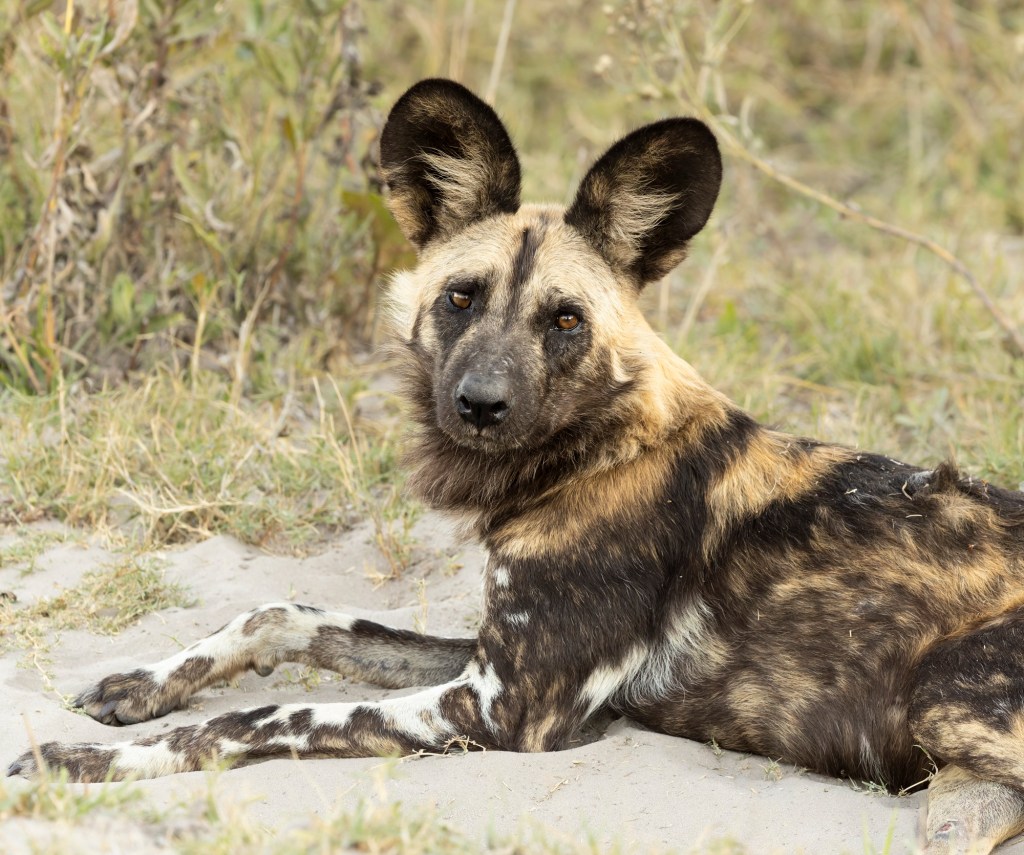
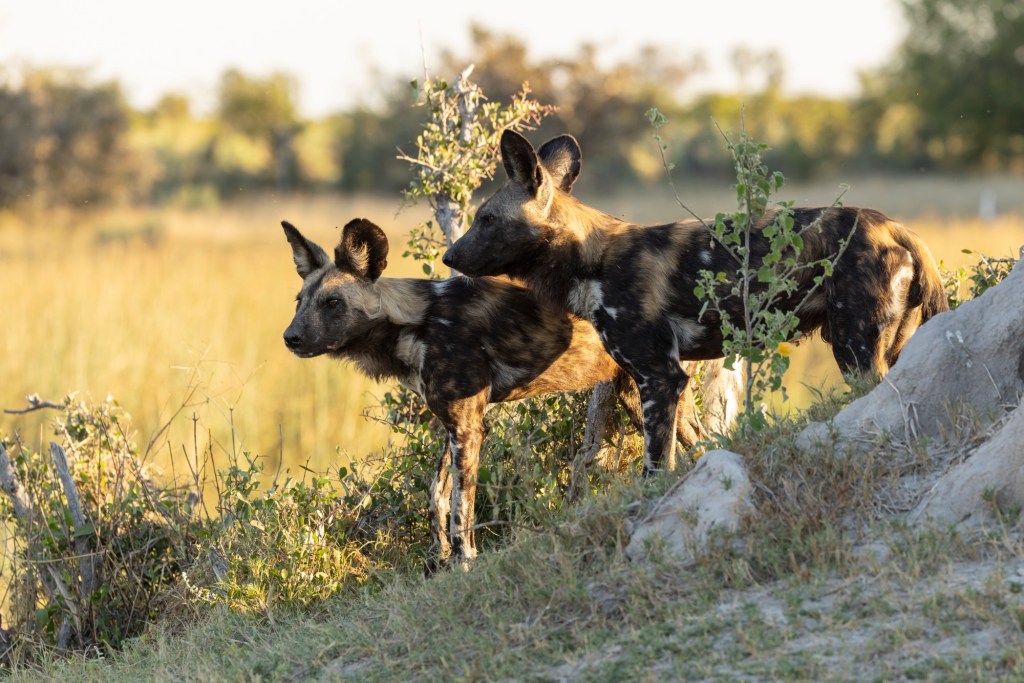
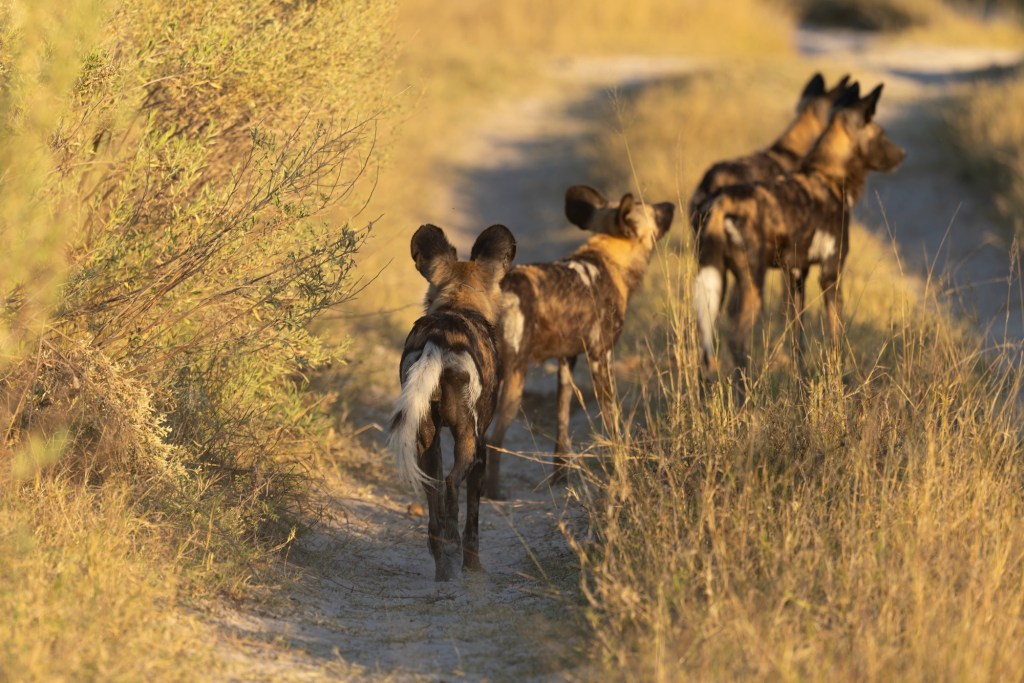
There then ensued an electrifying hunt during which the dogs pursued impala, alternating between running as a pack and separating to try and isolate their prey. We followed, all rooting for the dogs. “Come on, boys!” we urged, trying to keep our voices down as much as possible. I surprised myself but wanting to see them succeed but we knew that they needed food for their pups. Anyway, as Rhiannon says, impala are really just ‘fast food’.
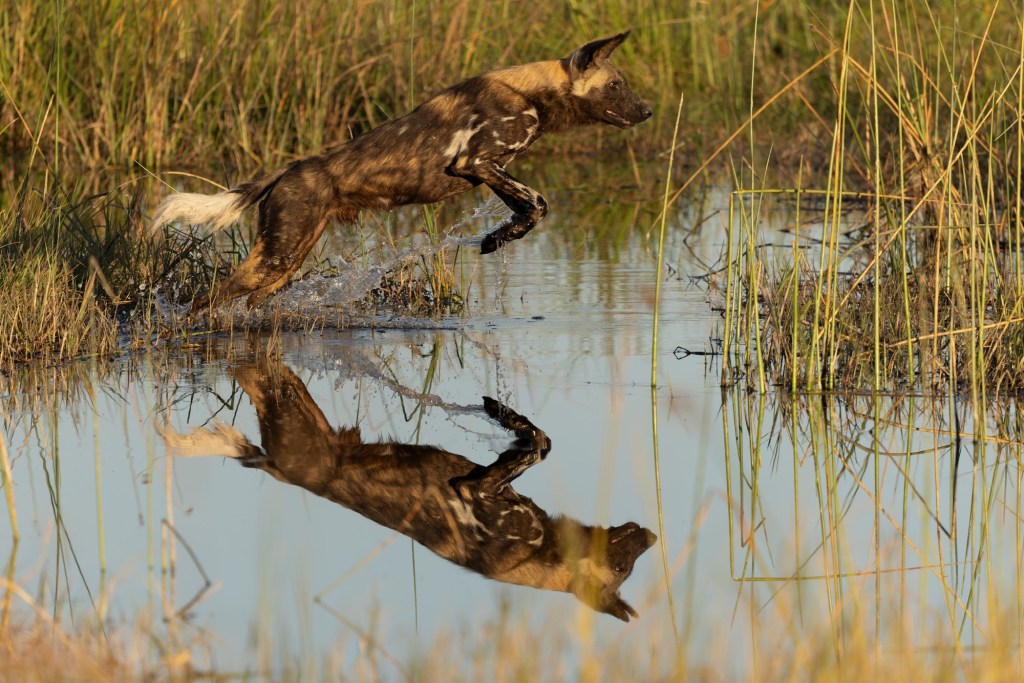
We followed for half an hour or so as they leapt over the water (Rhiannon took some incredible reflective shots) before seeing the injured dog chase impala in one direction whilst the other three sprinted after impala to the other side. We lost them when they ran through a thick bushy area and despite Joe’s best efforts could not find them again. We all agreed, however, that the thrill had definitely been in the chase.
Joe stopped once more on the way back and looked up thoughtfully. When asked, he explained that he knew something was up because “the doves are in the tree” and not on the ground. We learned that, rather than just looking and hoping to see predators, it is helpful to watch and listen to the other animals and birds. Joe taught us to listen for the “alarm call” – high pitched, repetitive calls emitted by birds when they see danger. The appearance of vultures can also assist as they circle round to alert others and check for predators. And, of course, nervous impala and zebra. The last thing you want to see is a relaxed impala.
We did not find the leopard so headed back to the camp for a three course meal of butternut squash soup and brioche rolls, pork rib and spaghetti followed by fruit and custard. I had a glass of South African Chardonnay and Rhiannon had another welcome drink! It had been a fantastic first day.
Back in bed, with her hot water bottle, Rhiannon began the long and time consuming task of “culling” her photographs before editing them. At one point, she let out a horrified gasp. She had captured some close up images of the wild dogs and realised that one of them had a snare around his neck. She determined to tell Joe about this.
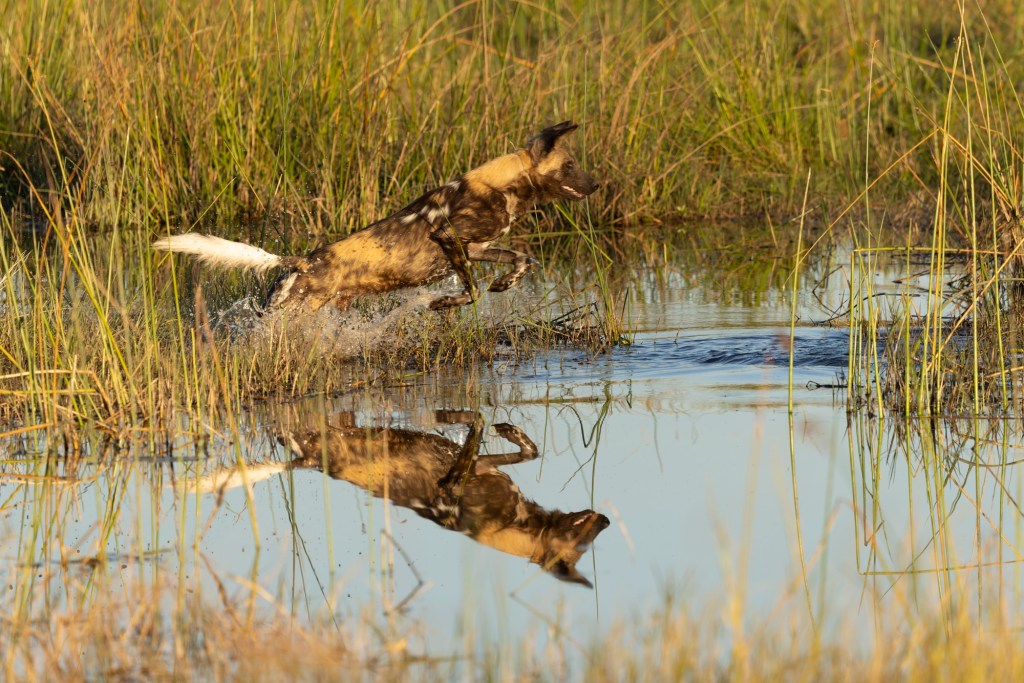
For some reason, her MacBook did not save all of the work she had done so she started again, bless her. I fell asleep, snuggled up under the blankets, and left her to it. She said it took her until 12:30am.


Leave a comment