Our last full day in Botswana. The lodge was strangely quiet when we went for breakfast. Rebecca’s group was leaving today so not venturing out with us. DC and Ona were driving us to Chobe for a full day’s experience. They picked us up in a mini bus. Travelling smoothly in a vehicle with seatbelts and heating felt strange. We missed the “natural air con” of the fresh air and being jolting from our seats.
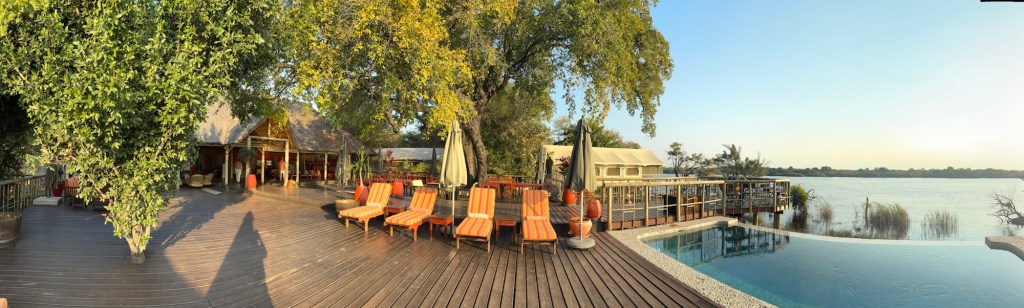
DC took us to Jackalberry, a high end lodge on the Chobe River. Just over three miles from Chobe National Park, it would be our base for the day. We had brunch overlooking the infinity pool which, in turn, overlooked the expanse of the Chobe River.
DC drove us to a nearby jetty where we boarded a square boat measuring 5 x 7 metres. We were the only passengers and free to walk wherever we wished. The guide was knowledgeable and friendly and – as most people had been – very interested in Rhiannon’s photography. He had an old Canon camera and was struggling to find a new battery. By the time we left, he was so impressed with the photographs she took that I suspected he would soon be investing in a new camera.
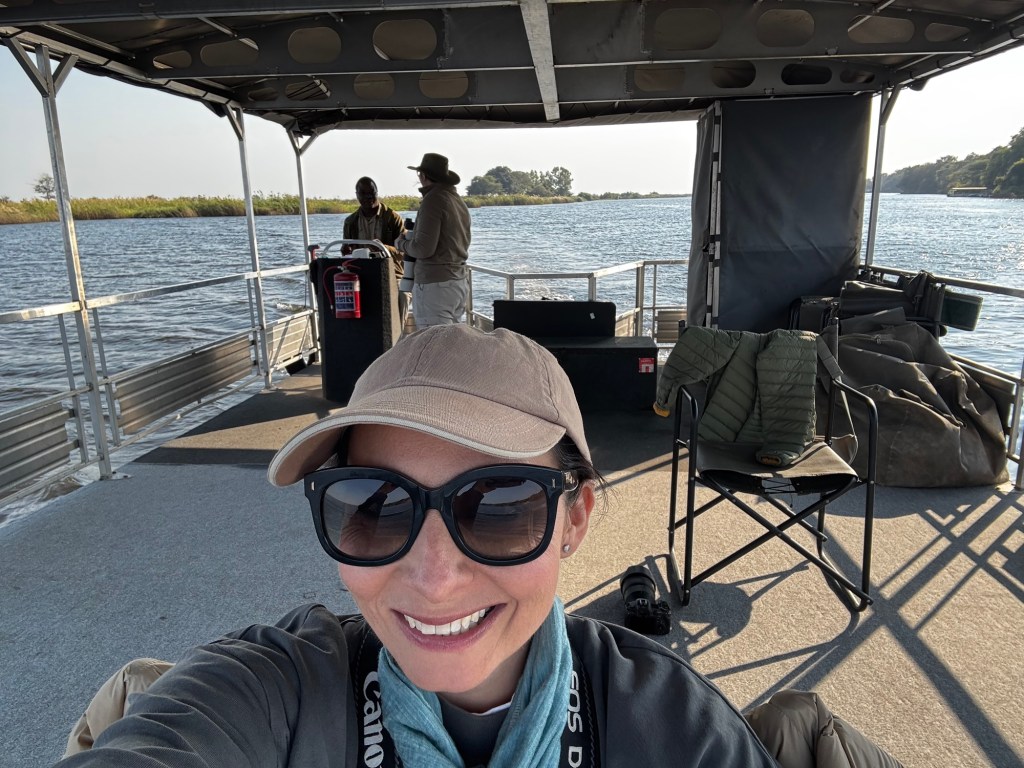
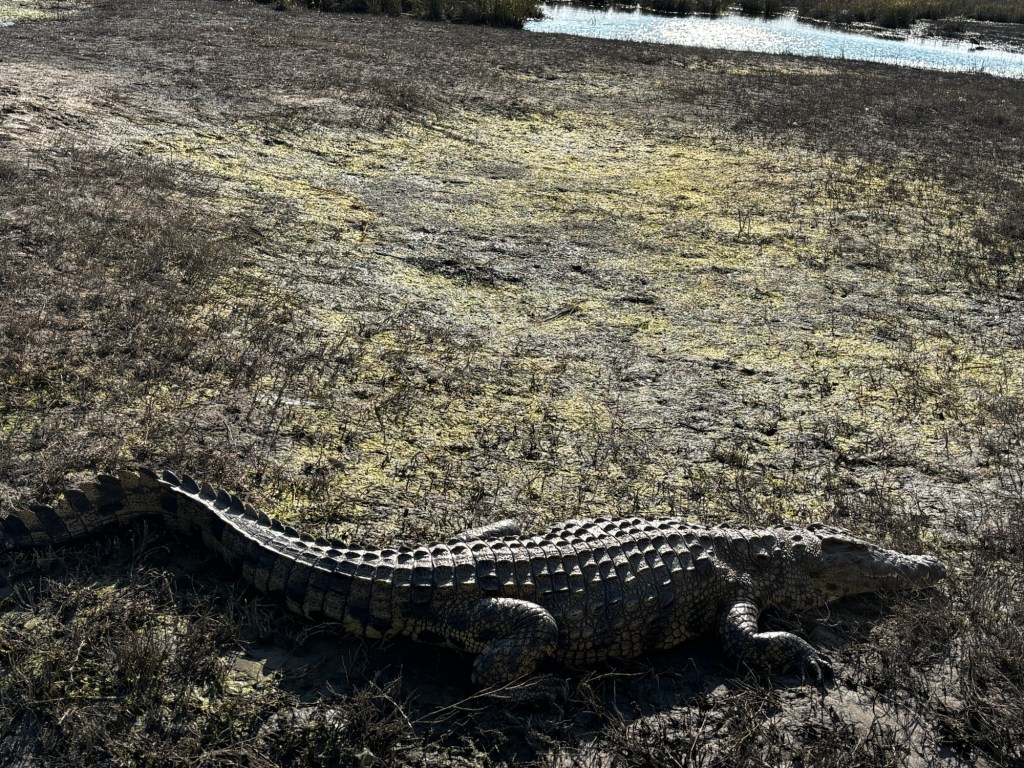
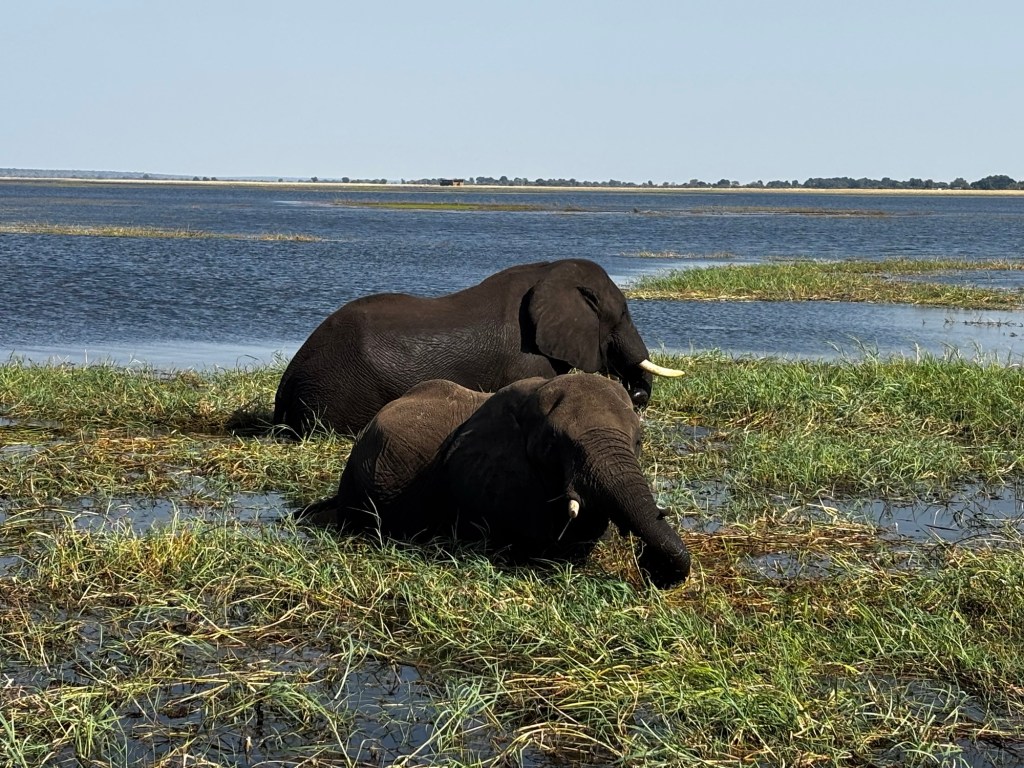
We sailed up and down the river for three and a half hours. We saw crocodile and hippos up close and personal and so many beautiful birds including jacana (called the ‘Jesus Bird’ because they ‘walk’ on water.) Best of all were the elephants. Chobe is the unofficial Elephant Capital of the World. We saw one male elephant waist high in water on a small island, happily munching grass. Our guide said that, as he had found a good source of tasty food, he would share the news. Elephants communicate by deep, low-frequency sounds inaudible to our ears. Sure enough, as we watched, another elephant appeared on the shore of Chobe National Park and proceeded to swim over to his friend.
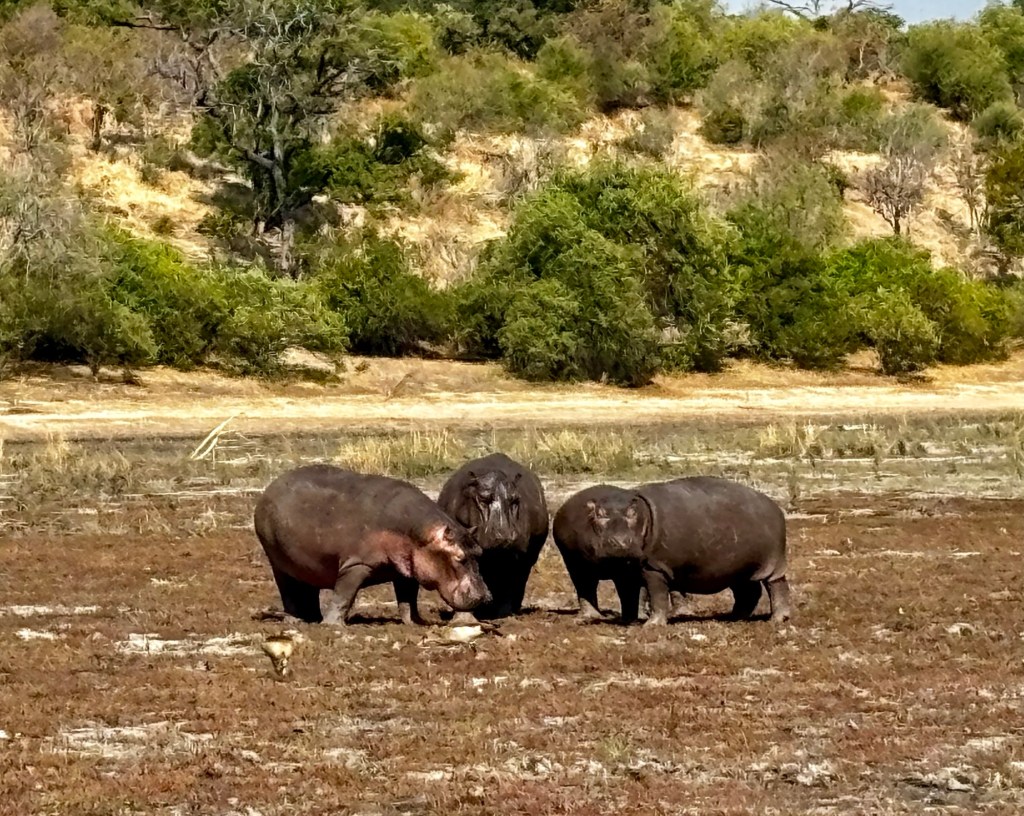
After a great experience, we returned to Jackalberry for fish and chips! It was the first time we had eaten chips in Botswana and, after a large brunch, we were both starting to feel uncomfortably full. We could have done with our fathers there to help us.
Our last game drive took place in Chobe National Park. Jerry, our guide, was to escort us for three hours. Although we did not ask the question, he told us from the outset that “we don’t see the big cats” every day. We knew, of course, that there was no guarantee of seeing any particular animal but Jerry did confirm that all animals can be found at Chobe and are free to come and go as they please. The park was so open and lush with a constant water supply that we suspected many were happy to stay.
After a few days of seeing next to nothing, it was so good to spot game again. The clearings between the trees made it so easy to see the animals. Impala, giraffes, warthogs, baboons and kudus were there in numbers. We had not seen male kudu before, now their long spiral horns were everywhere we looked. And the elephants! So abundant were they that, by the end, we were not even acknowledging these wonderful animals.
Jerry was a good guide, answering our questions and teaching us interesting facts.
“You see that?” he said, stopping by trees where baboons shook branches and impalas and kudus grazed underneath, “the baboons are throwing down leaves and flowers for the impalas and kudus to eat. They’re great friends. The baboons are “the eyes in the sky” and the impalas and kudus keep their noses to the ground.”
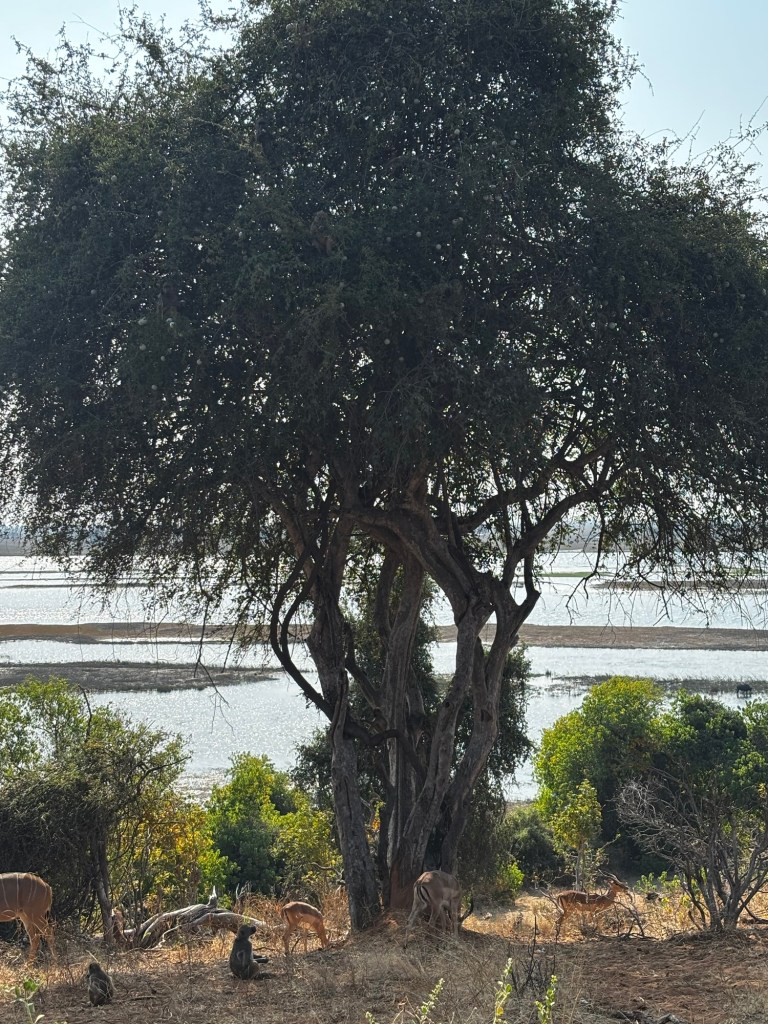
Always on the look out for the ‘warning signs’ Joe had taught us, we saw a solitary giraffe, standing and watching, and heard alarm calls ringing out from nearby trees. Jerry was on the case, especially after seeing impalas that could not relax. We all like to see a stressed impala.
As we followed where the giraffe was staring, we passed another car. Whilst Jerry and the other driver exchanged greetings in Setswanan, the Australian passengers told us excitedly that there were “lions just down there.”
And there they were. Three lions lying under the shade of the trees. Two young adult males together and their sister just a few trees away. We had never been so close to big cats. As with the leopard previously, a spurfowl was patrolling nearby, sounding the alarm. Jerry called him “the security officer”. I thought of him as Corporal Jones from Dad’s Army: “Lions! There are lions here! Don’t panic!”
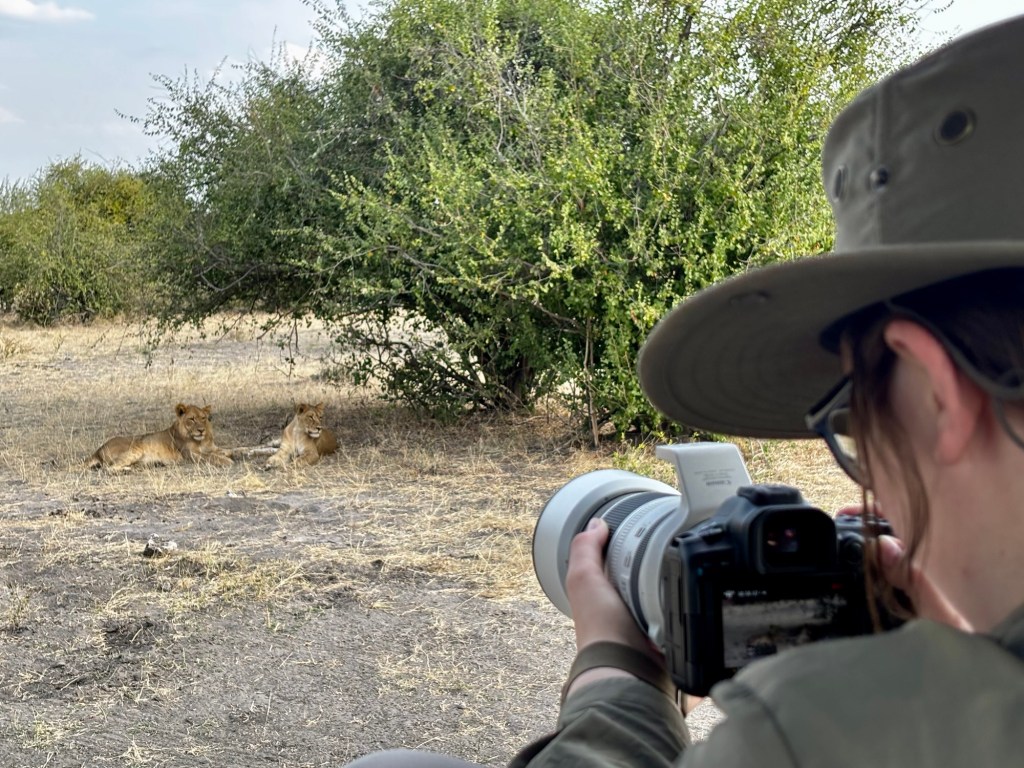
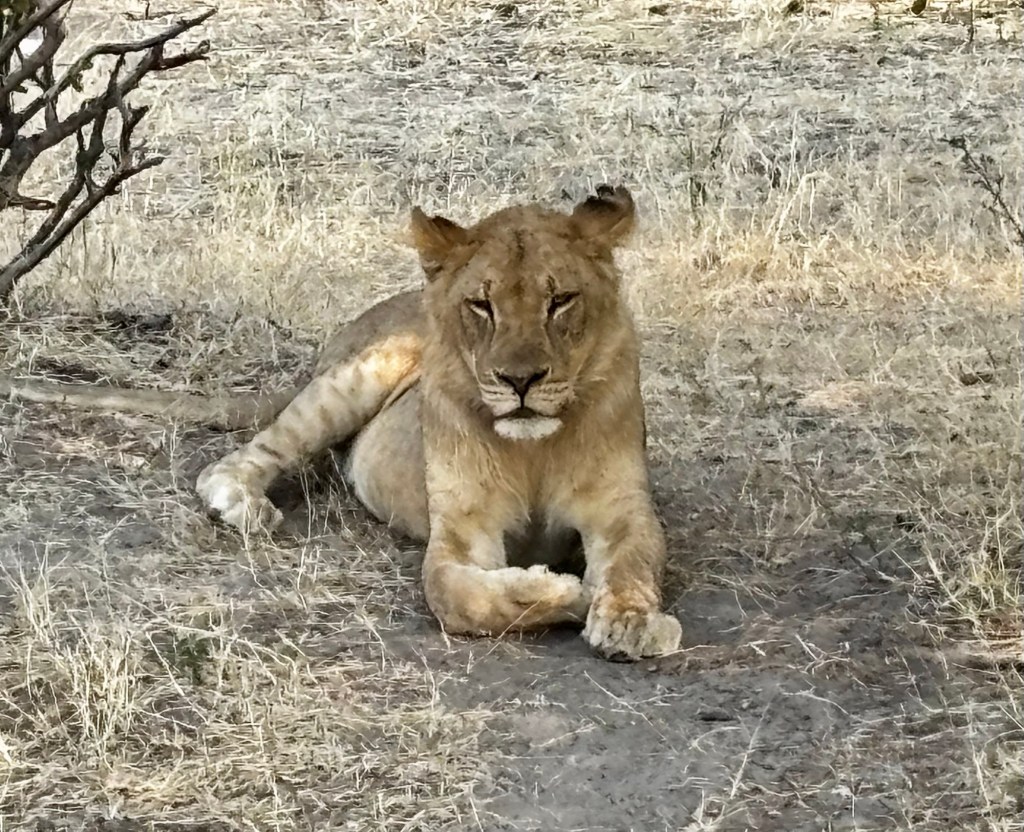
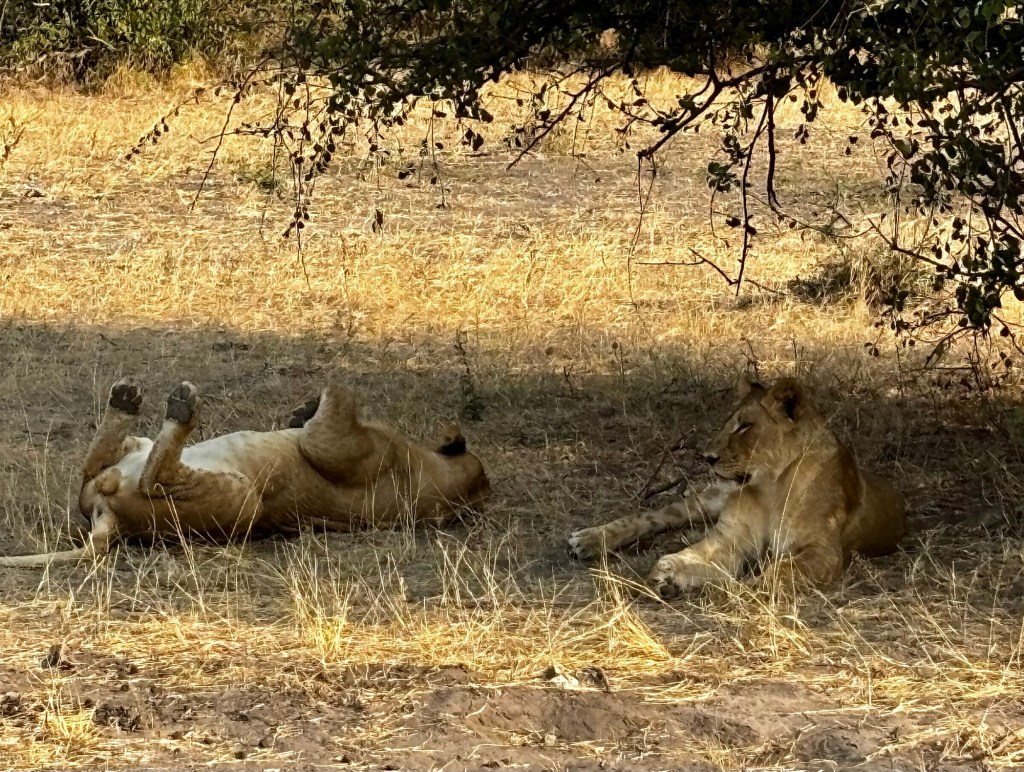
Seeing the lions was the glossiest cherry on the sweetest icing of the moistest cake. We had known that there was no certainty of seeing them. Had we wanted guarantees, we would have gone instead to a zoo but that would have paled by comparison. Seeing them in the wild, stumbling across them almost, was the greatest feeling. It felt as though we had achieved something even though the discoveries ‘we’ made were almost always attributable to the skill of the trackers and the hints shared by other animals and birds. We smiled happily as we enjoyed our last drinks break and then meandered to the exit,
On the way, Rhiannon made an unbelievable discovery of her own. Glancing at the back of a passing car, she saw a man and woman sitting, looking slightly underwhelmed, the woman wearing a red top and pink scarf. It was Claude and Claudine from Mogogelo! What were the chances? Très petit, I would have said.
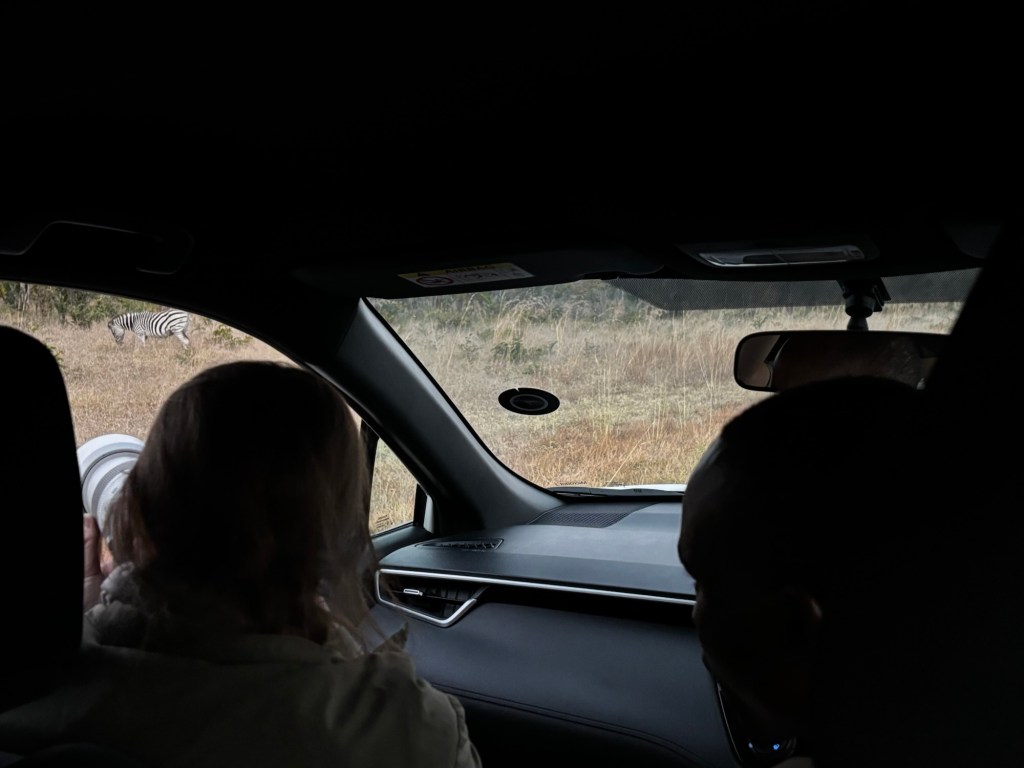
A new driver delivered us back to the camp. His name was Hups (“Hoops”) and he was a gem. Rhiannon sat in the front with him as I scribbled my notes in the back. They chatted all the way there. He was very interested in her photography, her education and Wales. He could not believe that sheep roam freely on our country roads without being stolen. He turned the journey into a mini game drive, stopping when we spotted zebra and ground hornbills and counting no fewer than eleven owls. Very cool, as Michelle would have said.
At the camp, we were met by Putsa who escorted us to our room. As I couldn’t find our key, Putsa left us outside whilst he went to retrieve the spare from reception. The silence was broken by an ominous sound: something between a groan and a whoop. It was coming from the bushes nearby.
“Is that a …..?” I was almost afraid to ask.
“A hyena” confirmed Rhiannon.
We looked at each other, beheld the locked door and the darkness all around us. Feeling slightly unsure of our safety and having learned all I know about hyenas from The Lion King, I asked Rhiannon the following question:
“Do hyenas eat British people?”
I meant adults, not British people.
Happily, Putsa arrived to let us in and, before long, we were in the bar ordering drinks. As usual, the quest to find Rhiannon a non-fizzy, non-alcoholic beverage was proving impossible. Who would have have thought that fruit juice would be more elusive than wild dogs? She settled for iced water.
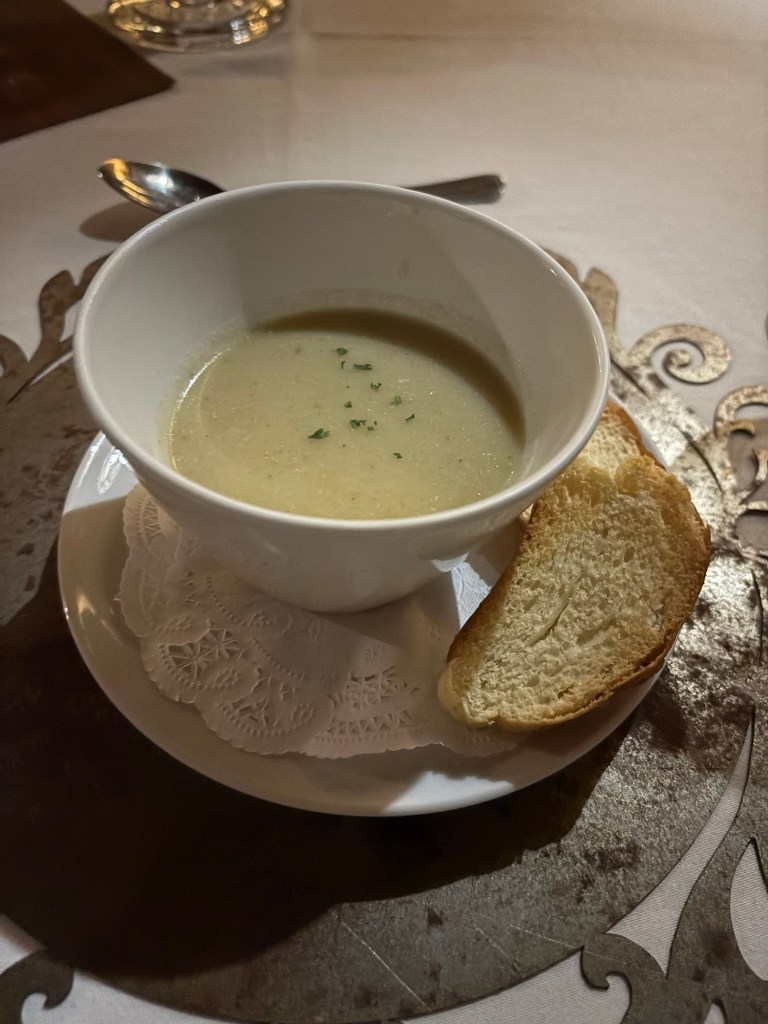
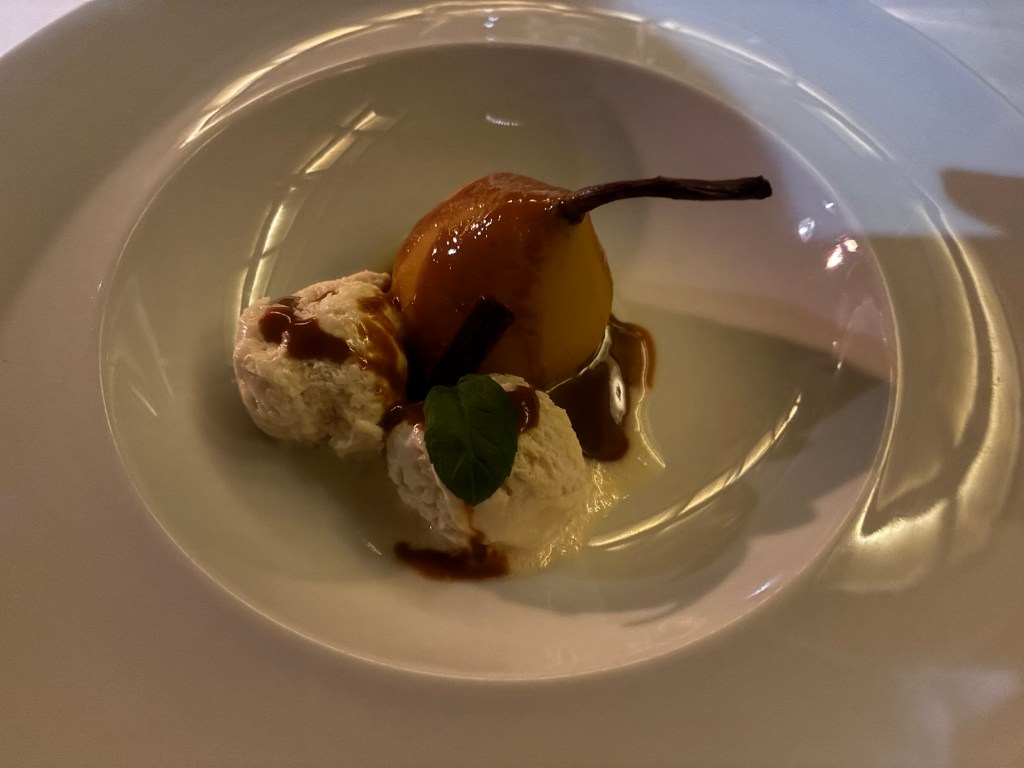
We had told Mavis that we were not hungry and did not need dinner but these words fell on deaf ears were ignored. We were served a three course meal comprising soup with cheese-covered croutons, fish served with potatoes and vegetables followed by poached pear and ice cream. I began to wonder whether we had stumbled into Hansel and Gretel’s gingerbread cottage and were being fattened up with delicious food before being eaten ourselves. Death by cannibals or hyena?
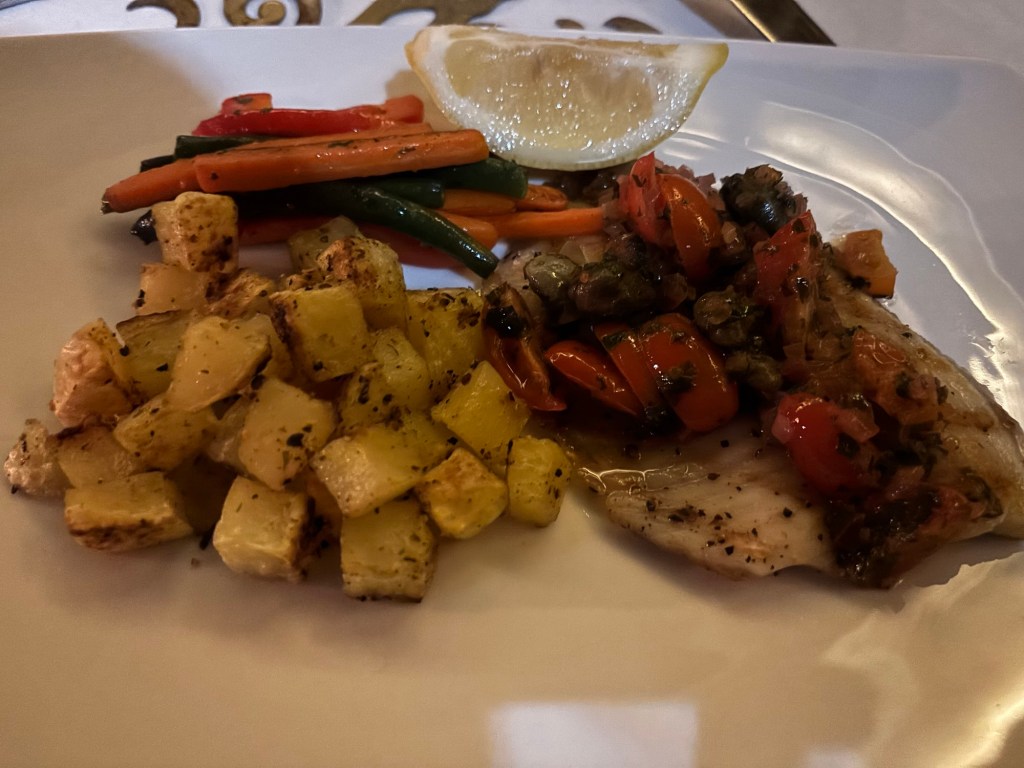
Rhiannon, who had tried everything she had been served during our time in Botswana, drew the line at her second fish of the day. Not wanting to hurt Mavis’ feelings (she was already upset after dropping a tray of dishes) and mindful of my promise to protect Rhiannon if and when needed, I told her to pass me her fish and, though I knew not how, I slowly ate as much as I could.
Rhiannon, surveying her almost empty plate and comparing it with mine: “Oh, I’ve done better than you!”
After dinner, we sat at the fire pit and met a couple from London who were just embarking on their safari as the sun was setting on ours. The woman fell asleep and started to snore whilst Fergus the dog and Hamish the cat battled it out around us. DC confirmed that a hyena might well attack a child but would not fancy its chances against an adult, British or otherwise.
 safarhis
Leave a comment